
Carried, Shared and Fitted
The three ways the Lab passes an ad's credit on to the pieces inside it, what each one adds up to, and which question each answers.
The attribution model splits an order between the ads that led to it. The atom model takes each ad's share one step further, to the pieces inside the ad: its hook, angle, avatar, offer, page and their properties, each an atom. You choose it at the top of the Lab, and in the Library's Performance lens.
In short
- Carried: every atom of an ad carries the ad's whole credit. The atoms together add up to more than the money.
- Shared: the ad's credit is divided among its atoms by a fixed rule. The atoms together add up to the money.
- Fitted: divided like Shared, but weighted by how much each atom was measured to do. Where nothing has been measured yet, it equals Shared. It is where the Lab starts.
One order, three ways
Take an order of $100, credited to one ad, whose creative carries five atoms: a hook, an angle, an avatar, an offer and a product. This is where the $100 goes under each model.
| Atom (stage) | Carried | Shared | Fitted |
|---|---|---|---|
| Hook (attention) | $100 | $35.00 | $35.00 |
| Angle (intent) | $100 | $15.00 | $22.50 |
| Avatar (intent) | $100 | $15.00 | $7.50 |
| Offer (conversion) | $100 | $30.00 | $30.00 |
| Product (basket) | $100 | $5.00 | $5.00 |
| All five | $500 | $100 | $100 |
Carried
Each atom carries the whole $100. It is what was present when the money came in: the five atoms show $500 between them, for a $100 order. Read one atom at a time, never a total.
Shared
The $100 is divided in three steps.
- By stage: 35% to attention, 30% to intent, 30% to conversion and 5% to the basket. A stage none of the ad's atoms belongs to drops out, and the others grow to fill its place.
- By dimension: a stage's share is divided equally among the dimensions present in it. The angle and the avatar each take half of intent's $30.
- By atom: a dimension's part is divided equally among its atoms, when an ad carries several of the same kind, such as an avatar's three desires.
A real creative carries more atoms than this one: a hook type, an emotional trigger, a format and your own properties share the attention stage with the hook, so each takes less.
Fitted
The same steps, but inside each stage the atoms take shares in proportion to their effect. Here the Lab measured the angle at 1.5 times its average angle and the avatar at 0.5 times the average avatar, so the angle takes three quarters of intent's $30: $22.50 against $7.50.
An atom whose effect has not been measured counts as average, which is why Fitted equals Shared until there is evidence. See Effect vs family.
The same atoms under each model
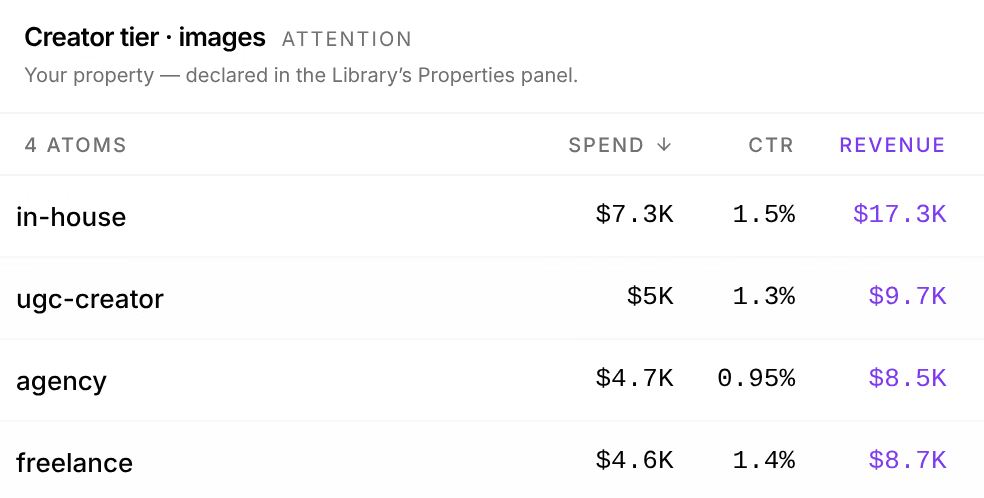
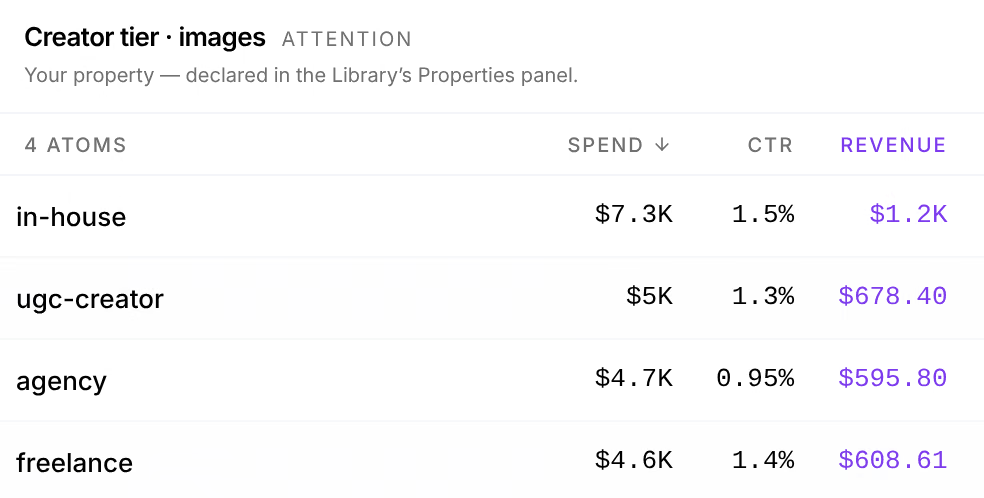
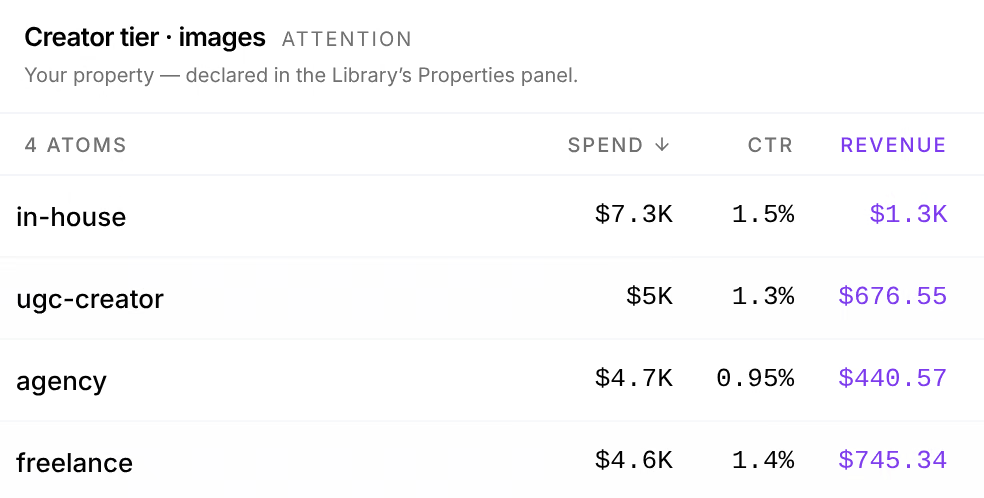
Switching the model changes what is credited, not what was measured. At the top of this page, the demo store's four creator tiers under Carried: in-house images carried $17.3K of revenue. Under Shared, each tier keeps only its part of every ad's credit: $1.2K for in-house. Under Fitted, the part leans toward the tiers the Lab measured stronger: agency, called a loser, falls from $595.80 to $440.57, and freelance, called a winner, rises from $608.61 to $745.34.
Shared
Fitted
These change with the model: the credited Revenue, Orders and POAS of each atom. These do not: spend, impressions and the rates; the effect, its interval and P>family, which come from the fit; the call; and Incremental, which always compares an atom with the average atom of its dimension.
Which one to use
| Name | What it does | Default or limit |
|---|---|---|
| Carried | How much money came in on ads that carried an atom. Before you retire a hook, see how much revenue still rides on it. | |
| Shared | Figures that add up, by a rule anyone can check. To split last month's revenue by angle in a report. | |
| Fitted | The Lab's best estimate of what each atom earned. To decide what to make more of. | Default Default |
Where this shows up
- Attribution LabThe Lab credits revenue to each hook, angle, avatar, offer and page inside your ads, and says how sure it is of each one.
- How to read the numbersEvery figure in Analytics depends on its period, its attribution model, where it comes from and how much of your spend it covers.
- How Omnymous worksOmnymous builds your ads from reusable pieces, launches them, and credits every order back to the pieces that earned it.